April 21, 2026
Meta TRIBE v2: The AI That Reads Your Audience's Brain Before They See Your Ad
What if you could predict how your audience's brain responds to your ad before you spend a single dollar on media? Meta's TRIBE v2 is a foundation model that predicts neural responses to sight, sound, and language in seconds — and it's about to change how the smartest brands plan their campaigns.
What if you could see how your audience's brain responds to your ad — before you spend a single dollar on media? That's exactly the door Meta is opening with TRIBE v2, a new AI foundation model that predicts neural responses to sight, sound, and language in seconds.
Marketing has always been about understanding your audience. Focus groups, A/B testing, heat maps, eye tracking — we've built an entire industry around trying to figure out what resonates. TRIBE v2 represents something fundamentally different: a model trained on actual human brain data that can simulate how a typical person's brain reacts to any piece of content you throw at it.
What Is Meta TRIBE v2?
TRIBE v2 — Transformers for Brain Encoding, version 2 — is an AI foundation model built by Meta's research team. It predicts fMRI (functional MRI) brain activity across 70,000 brain voxels in response to visual, auditory, and textual stimuli. Put simply: you feed it a video, audio clip, or piece of text, and it tells you which parts of the brain light up and how strongly.
Released as fully open source — code, model weights, and research paper all publicly available — TRIBE v2 is positioned as a neuroscience research tool. But its implications for anyone trying to understand how people respond to content are enormous. It was trained on large cohorts of subjects exposed to a wide variety of media, and it can accurately predict brain responses for new stimuli and subjects it has never encountered, without any retraining.
How TRIBE v2 Works: A Three-Stage Architecture
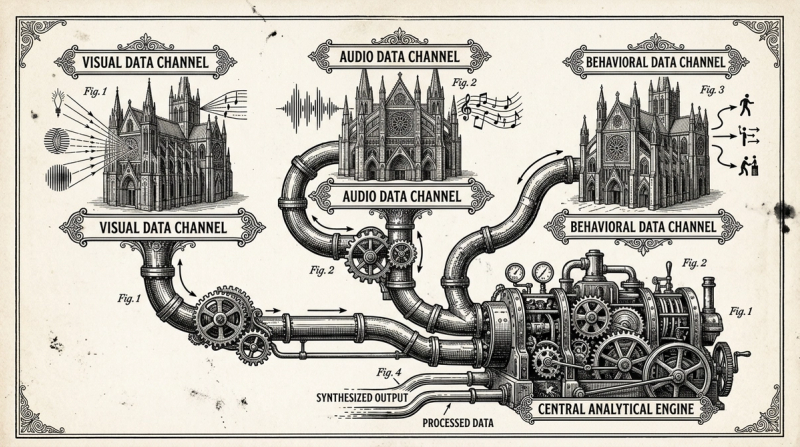
The model processes content through an elegant three-stage pipeline that mirrors how the human brain itself integrates sensory information.
Stage 1 — Tri-modal Encoding
TRIBE v2 starts by using pretrained AI embeddings for audio, video, and text. These capture the same kinds of features that have made modern AI models powerful — visual patterns, acoustic properties, semantic meaning — and align them with how the human brain processes each modality. This stage essentially translates raw content into a language both AI and neuroscience can share.
Stage 2 — Universal Integration
A transformer architecture then fuses all three embeddings into a unified representation that captures how sights, sounds, and language interact with each other. This mirrors how our brains don't process sensory inputs in isolation — we experience a TV commercial as a single coherent event, not three separate streams. The transformer learns these cross-modal relationships at scale.
Stage 3 — Brain Mapping
Finally, a subject-specific layer maps the unified representation onto predicted brain activity across the full cortex — 70,000 voxels, compared to the 1,000 cortical predictions of the original TRIBE v1. This is a 70x leap in resolution, delivering a far more detailed and precise picture of neural engagement across the entire brain.
The Breakthroughs That Make This Commercially Interesting
Several aspects of TRIBE v2 make it far more than an academic curiosity for anyone thinking about how people respond to content.
Zero-Shot Generalization
The model can predict brain responses to completely new content without any retraining — achieving a 2–3x improvement over standard methods on auditory and visual datasets. This means a brand could theoretically input a brand new ad creative and get an immediate prediction of neural response with no lab setup required.
More Accurate Than an Actual fMRI Scan
This is the most remarkable finding. Real fMRI recordings are noisy — distorted by heartbeats, breathing, and movement artifacts. TRIBE v2's predictions are actually more correlated with the average group brain response than almost any single fMRI recording. You get a cleaner, more representative neural signal from the AI model than from the actual scanner. That's a paradigm shift.
In-Silico Experiments
By simulating classic neuroscience protocols entirely in software, TRIBE v2 can identify which brain areas activate for specific content categories: Places, Bodies, Faces, Speech, Semantics, and Emotions. For marketers, this is a roadmap to understanding what your content is actually triggering at a cognitive level.
Scaling Laws That Promise More to Come
TRIBE v2 follows a scaling law: performance improves log-linearly as it's trained on more data, and it hasn't plateaued. This model is only going to get more accurate as more fMRI data becomes available. What you're seeing today is the floor, not the ceiling.
How Companies Can Leverage TRIBE v2 for Marketing Campaigns
Let's map TRIBE v2's capabilities directly onto real marketing workflows. This is where the model goes from interesting research to practical competitive advantage.
Pre-Launch Creative Testing at Zero Cost
Today, brands spend months and significant budget on focus groups, eye tracking, and EEG neuromarketing studies to validate ad creative. TRIBE v2 compresses that feedback loop to seconds of computation. Feed it your video spot, and get a prediction of which brain regions activate, how strong the response is, and whether the neural signature maps to high-attention or emotional-engagement patterns — all before a single dollar goes to media.
Emotional Resonance Scoring for Brand Campaigns
The model specifically identifies activation in brain areas associated with emotions, faces, and semantic processing. Brands running campaigns built on emotional connection — insurance, healthcare, luxury, non-profit — could score multiple creative variations against this neural baseline. The version that generates the strongest, cleanest signal in emotion and social processing areas goes forward.
Sound and Music Optimization
Most neuromarketing tools focus almost entirely on visual stimuli. TRIBE v2 is tri-modal, which means it processes audio with the same rigor as video. Brands can test voiceover tone, background music, jingle cadence, and audio pacing for neural impact alongside visuals. Given how underinvested audio branding is relative to its cognitive impact, this is a big unlock.
Copy and Messaging Validation
The language processing capabilities mean you can test how different headlines, taglines, or scripts activate semantic processing areas in the brain. Copy that produces stronger, cleaner neural signatures in language regions is likely to be more memorable, more comprehensible, and more persuasive. This gives copywriters and strategists a biological signal to optimize against — not just click-through rates.
Neuro-Informed Audience Segmentation
As the technology matures and is further applied in commercial contexts, there's potential for mapping different content archetypes to different neural response profiles — enabling a form of audience segmentation grounded in biology rather than purely in behavioral proxies. Different creative approaches may activate different cognitive systems, and knowing that changes how you structure a campaign.
What This Means for the Industry
The implications go beyond faster A/B testing. TRIBE v2 represents a shift toward what we might call neural-informed creative strategy — a world where creative decisions are informed not just by past behavioral data, but by predicted biological responses to content that hasn't even aired yet.
Agencies and brands that invest in understanding these tools now will have a meaningful advantage. Not because the model is plug-and-play for marketing today — it isn't — but because the underlying technology is advancing fast and the first movers will define best practices. Meta has released TRIBE v2 as fully open source, which means forward-thinking teams can start experimenting on their own content immediately.
How to Explore TRIBE v2 Today
Meta has made the following available to the public: an interactive demo at aidemos.atmeta.com/tribev2 where you can see actual vs. predicted brain activity side by side for a range of stimuli, downloadable model weights, the full open-source code on GitHub, and the research paper for technical depth. The demo alone is worth exploring — seeing real and AI-predicted brain scans overlaid is one of those moments that makes the implications land immediately.
The Bottom Line
Meta TRIBE v2 is not a marketing platform — it's a neuroscience research model. But the distance between where it is today and where it could slot into a standard creative testing workflow is smaller than most people think. The ability to predict how a human brain responds to any piece of content — before that content reaches an audience — is a genuinely transformative concept.
The brands and agencies that start thinking about this now, even just at a conceptual level, will be better positioned when neural prediction becomes part of the standard creative testing workflow. Based on the scaling laws TRIBE v2 is following, that day may not be as far off as it seems.